A PR box has two jobs that pull in opposite directions. It has to look flawless the moment a creator lifts the lid on camera, and it has to survive a cross-country trip through a carrier network that treats every parcel the same. Those goals live in different parts of the package, and the specification that satisfies both comes down to a few board grades and one shipping formula that quietly sets your bill. Here is how to read them before you approve artwork.
How to read a board grade
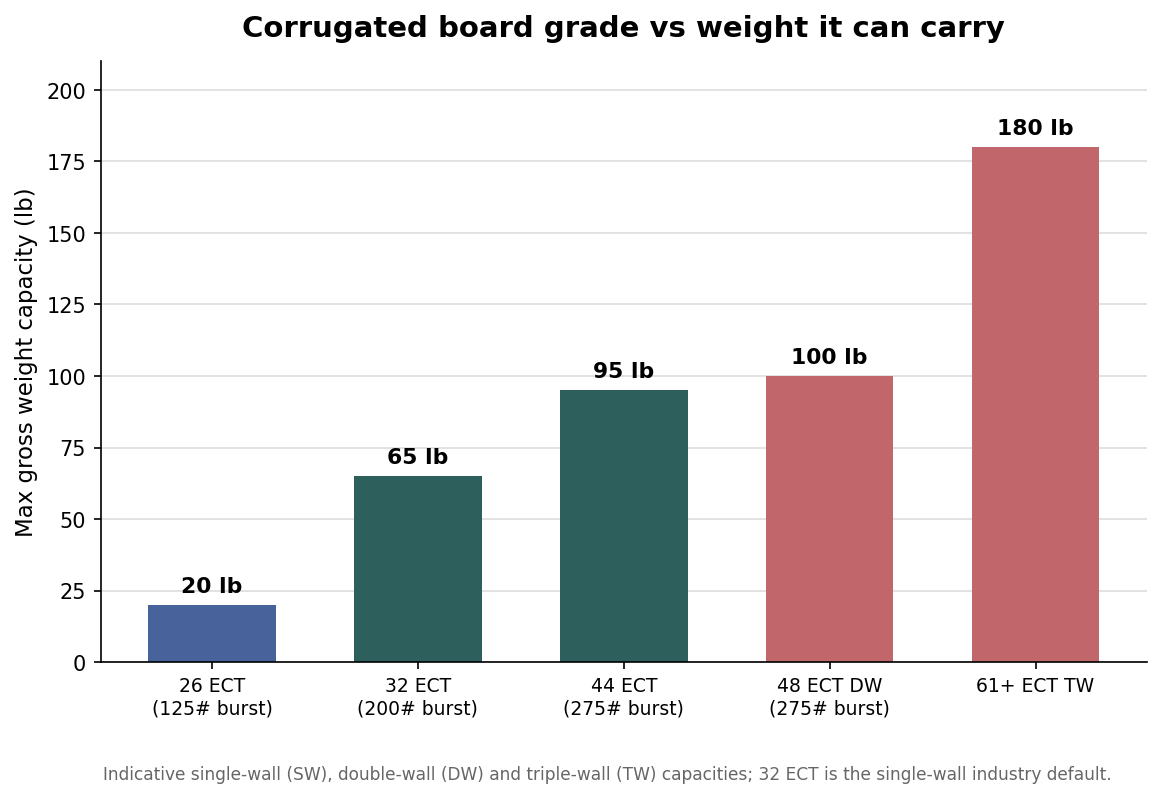
Corrugated board is rated two ways, and a spec sheet usually shows both. The Edge Crush Test (ECT) measures top-to-bottom stacking strength — how much pressure the walls take before they crush, which is what matters when boxes sit stacked on a pallet or under other parcels in a truck. The Mullen or burst test measures how much pressure the wall takes before it ruptures, which speaks to puncture and rough handling. A single-wall 32 ECT board, equivalent to a 200-pound burst rating, is the industry default and carries a gross weight up to roughly 65 pounds. Step down to 26 ECT and you are limited to about 20 pounds; step up to 44 ECT, or a 275-pound burst rating, and you reach about 95 pounds. Double-wall board near 48 ECT handles roughly 100 pounds, and triple-wall grades go well beyond that. For a PR box, whose contents are usually light, the grade is less about weight and more about keeping edges crisp and corners square after handling.
The box inside the box
The trap most first-time buyers fall into is asking one box to be both the beautiful unboxing piece and the shipping container. The printed PR box — the one with your foil, your color, your magnetic lid — is almost always built from a thin micro-flute board, E-flute at about 1/16 inch or the even finer F-flute, precisely because a thin, tight surface prints sharply and folds cleanly. That same thinness is poor protection in transit. The reliable pattern is a two-part system: the presentation box travels inside a plain 32 ECT corrugated shipper, cushioned so the pretty box arrives with unblemished edges. It costs a little more and adds a few ounces, but it is the difference between a creator filming a pristine reveal and filming a dented lid.
If budget forces a single box, specify a sturdier board for the printed box itself and design the artwork to hide scuffs. Darker colors and matte finishes forgive handling marks far better than gloss white, which shows every scrape and fingerprint the network leaves behind.
Why box size, not weight, sets your bill
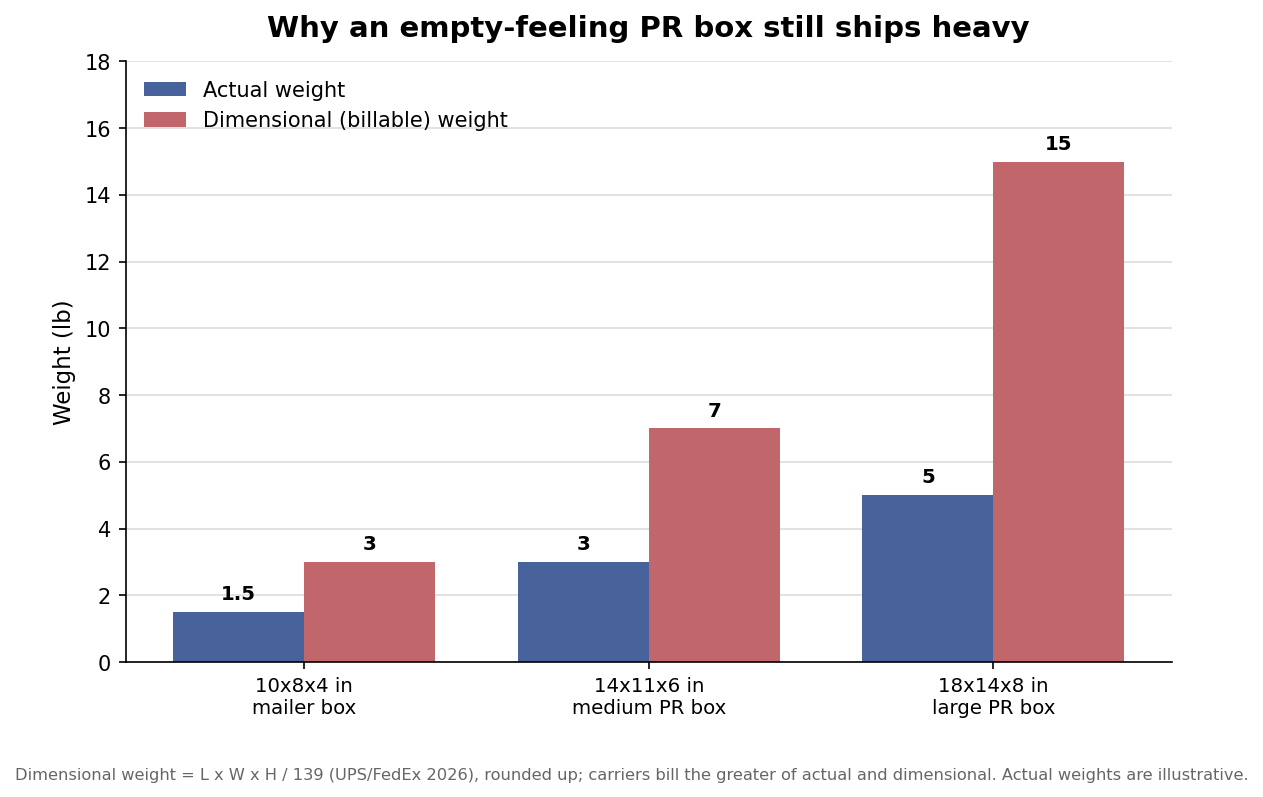
PR boxes are light and roomy, which is exactly the profile carriers price most aggressively. UPS and FedEx bill on dimensional weight: multiply length by width by height in inches, divide by 139, then compare that figure to the actual scale weight and charge whichever is greater. A box that weighs three pounds but measures 14 by 11 by 6 inches works out to 924 cubic inches over 139, or about seven pounds billable — more than double its real weight. Scale the box up to 18 by 14 by 8 inches and the billable figure jumps to roughly fifteen pounds, no matter how little sits inside. The lesson is to size the box to the product with intent, because every empty inch is billed as if it were full.
One 2026 detail sharpens this further. Since the rule change that took effect in August 2025, carriers round every fractional dimension up to the next whole inch before running the formula. A box measured at 11.1 by 8.5 by 6.2 inches is billed as 12 by 9 by 7, which in that example lifted the billable weight by nearly 40 percent. When you approve a die line, the outside dimensions are a cost decision, not only an aesthetic one.
Protecting what is inside
Void fill is the unglamorous line item that saves the campaign. The goal is to immobilize the contents so nothing shifts, rattles, or presses against the lid during transit. Molded pulp and die-cut foam inserts hold products in a fixed position and double as part of the reveal, which is why they earn their cost on a premium kit; loose fill and crumpled paper protect adequately but read as cheap on camera, so keep them to the outer shipper where the creator never sees them. For fragile beauty items — glass droppers, pressed powders, anything that shatters or cracks — plan for at least an inch of cushioning on every side and test a packed sample by shaking it. If you can hear or feel movement, the insert is not doing its job yet.
Specifying it right
Bring the whole picture together before you sign off. Decide the finished product first, then size the printed box to it with as little dead air as possible. Choose a micro-flute printed box for the reveal and pair it with a 32 ECT shipper unless the contents are unusually heavy, in which case move to 44 ECT or double-wall board. Run your outside dimensions through the dimensional-weight formula so the shipping cost is a number you chose rather than one that surprises you at invoice time. And approve a physical packed sample, shaken and inspected, before you commit to a production run — the few days that adds is far cheaper than a warehouse of boxes that dent in the mail.
Leave a Reply