A PR box is unusual among packaging jobs because it has two audiences that never meet: the carrier that throws it across a hub at two in the morning, and the creator who films opening it in soft light for an audience of thousands. Brands obsess over the second and forget the first, and that gap is where most PR box budgets quietly leak. The box that looks flawless in a mockup can arrive dented, over-billed, or full of a product that rattled loose in transit. The mistakes below are the ones that show up after the artwork is approved, when it is expensive to fix.
Sizing the box for the reveal instead of the shipment
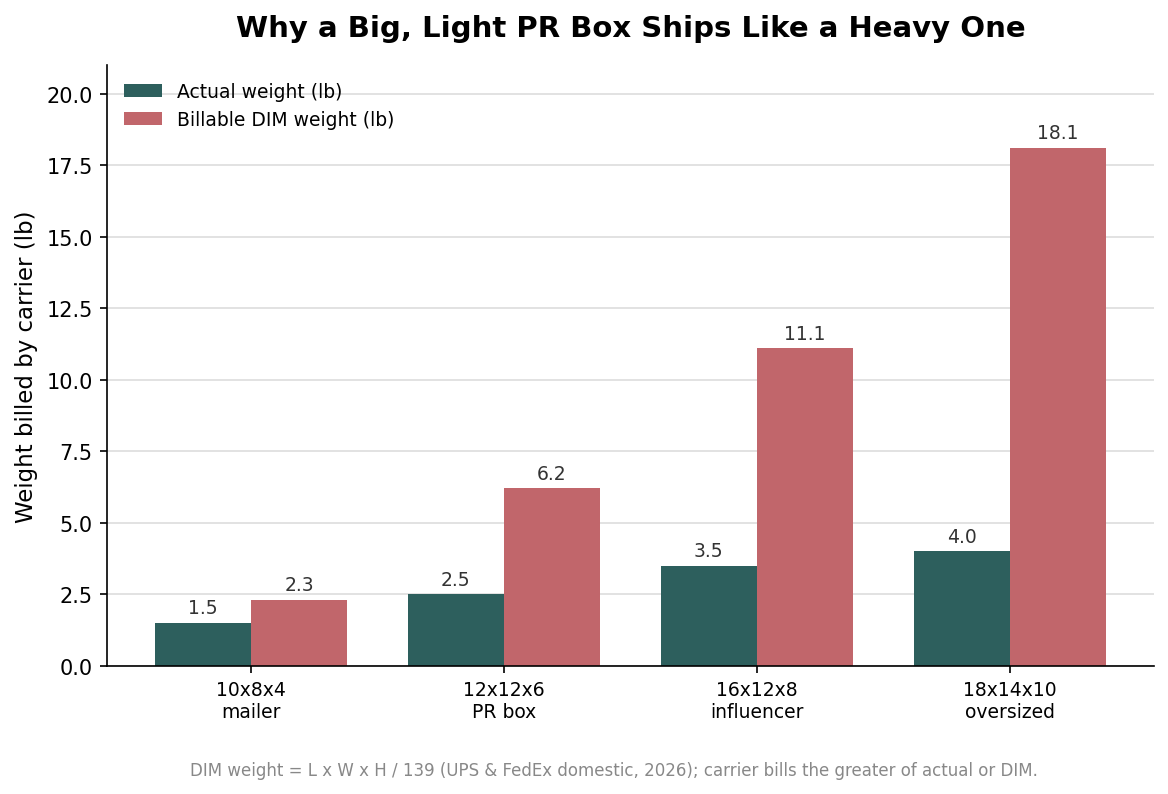
The most costly error is dimensional, and it never appears on the design proof. Carriers do not bill a light box by its weight; they bill it by the space it occupies, using dimensional weight. For domestic UPS and FedEx shipments in 2026, the formula is length times width times height divided by 139, with each dimension rounded up to the next whole inch, and you pay whichever is greater, the actual weight or the DIM weight. A generous 16 by 12 by 8 inch influencer box that weighs three and a half pounds calculates to about eleven pounds of billable weight. Push it to 18 by 14 by 10 and you are billed for roughly eighteen pounds while shipping four. That is the same box costing four to six times its true weight on every single unit you send.
The fix is not a cramped box; it is an honest one. Trim an inch off each dimension and the DIM weight falls by a wide margin, because volume is cubic. Design the reveal around a box that is full rather than one that is airy, and you keep the drama without renting empty air from the carrier on every shipment.
Treating the insert as an afterthought
The interior is not filler; it is the difference between a product that presents itself and one that tumbles out. A well-made insert holds each item at a set angle so the hero product faces the camera the moment the lid lifts, and it stops the contents shifting on a conveyor. The common failure is ordering a beautiful outer box and then dropping the products into loose crinkle paper, which photographs as clutter and offers almost no real protection. An insert is also where a mid-tier box starts to feel premium, because the hand feels the resistance of a fitted cavity before the eye has processed anything. There is a production cost to this discipline: a custom-shaped insert usually needs its own die or mold, which adds a one-time tooling charge and a few extra days to sampling, so it is worth locking the product lineup before that tool is cut. Reordering a die because a product changed size is the kind of avoidable expense that a fixed packing plan removes entirely.
Matching the wrong insert to the product
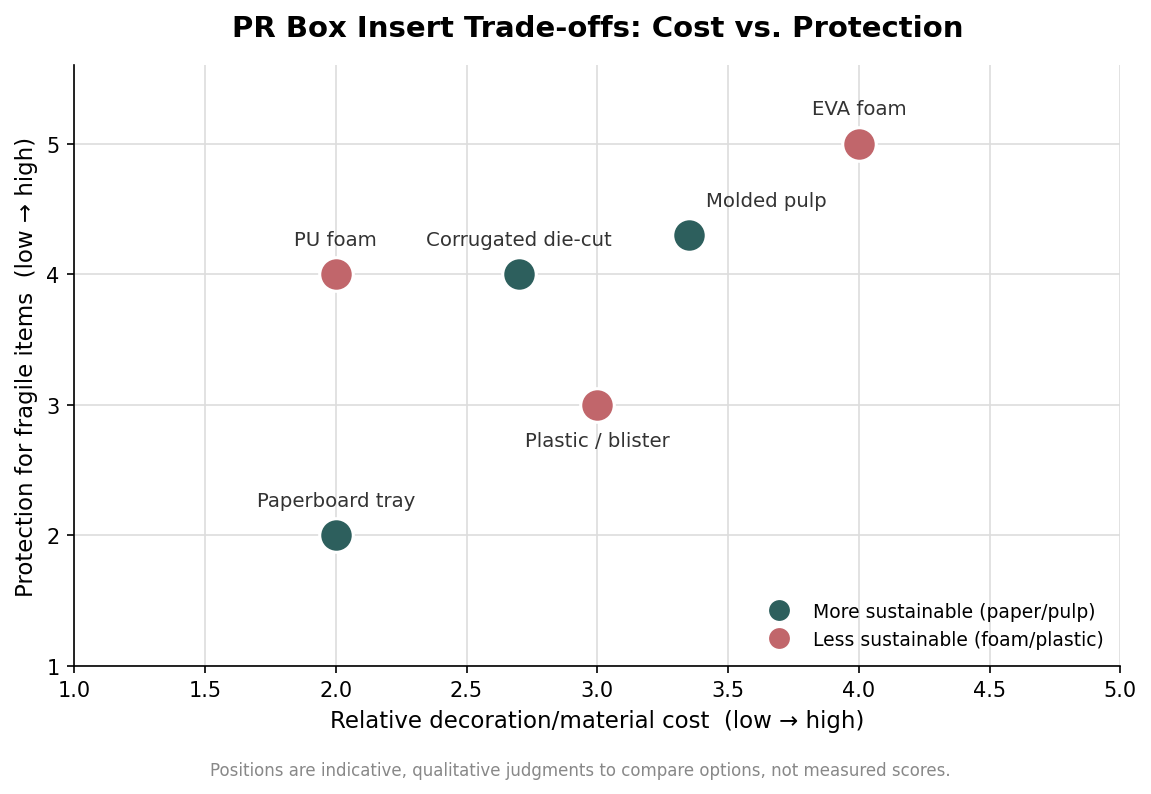
Insert material is a real decision with real trade-offs. Corrugated die-cut trays, built from E-flute at roughly 1.2 to 2 millimeters or sturdier B-flute at 2.55 to 3 millimeters, are recyclable, mid-priced, and strong enough for most fragile goods. Molded pulp forms a custom cavity from recycled fiber and is the natural choice when sustainability is part of the brand story. Paperboard trays at 300 to 400 gsm suit light items and keep cost down. Foam gives the most cushioning and the most premium grip, with denser EVA feeling more luxurious than open PU, but neither is biodegradable, so it fits electronics and glass more than an eco-forward launch. Plastic and blister inserts mold to any shape but carry weight and sustainability penalties that increasingly clash with creator audiences.
The mistake is defaulting to whatever the supplier stocks. A glass serum bottle needs a snug foam or molded-pulp cradle; a set of sachets needs nothing more than a paperboard tray; a candle needs a deep corrugated well that stops it sliding into the lid. Choose the insert for the fragility and the story, then let cost follow.
Ignoring what the carrier does to the outside
Even a perfect interior fails if the exterior cannot survive handling, and 2026 made this harder to ignore. Both major carriers now run automated three-dimensional scanning at their hubs, and a box whose real dimensions differ from what was declared triggers an automatic correction charge, arriving within about three weeks. Industry reporting puts the share of parcels catching at least one correction at roughly five to twelve percent, at an average of two to six dollars each. On a seeding run of a few hundred boxes, that is a line item that appears a month later with no warning. Declare the true outer dimensions, account for the thickness a rigid box adds over its interior size, and the surprise disappears.
Getting it right without overbuilding
None of this argues for a heavier, more expensive box; it argues for a deliberate one. Size the outer box to the contents so DIM weight stays close to actual weight, specify an insert that matches the fragility of what is inside, and declare honest dimensions so the carrier’s scanner has nothing to correct. A PR box built this way costs less to ship on every unit, arrives intact often enough to trust with press and talent, and still delivers the clean, full, camera-ready reveal that is the entire point of sending one. The reveal and the shipment are not competing goals; they are the same box, specified with both audiences in mind from the first proof.
Leave a Reply