The outside of a PR box earns the first reaction, but the insert decides two things that matter more: whether the product arrives intact and whether the reveal looks deliberate instead of thrown together. A hero product rattling around in loose shred reads as careless on camera, and a cracked item never gets filmed at all. Choosing the insert is really a four-way trade among protection, presentation, sustainability, and cost, and for PR boxes sustainability carries extra weight, because the creators you are courting will happily call out wasteful packaging to the exact audience you are trying to reach.
The four insert families and what each is really for
Die-cut foam (usually EVA or polyurethane) is the protection benchmark. Cavities are cut to the exact silhouette of your product, so a heavy or fragile item sits locked in place with real shock absorption around it. Foam also has the most premium hand-feel, especially when faced with a cloth or silk layer, which is why luxury and electronics kits lean on it. Its weakness is environmental: it is plastic-based, not curbside recyclable, and comes in a limited palette, typically black or white.
Molded pulp, also called molded fiber, is pressed from recycled paper into a custom contoured tray. It fits products precisely and looks clean and intentional, and it is compostable and recyclable, which is the single biggest reason it keeps replacing foam in beauty and premium retail. It cushions well, though not quite to foam’s level, and its print options are limited to the natural fiber look. Paperboard trays and platforms are folded or die-cut from printable board, so they take full-color graphics across the whole insert and are the most brandable option, best suited to lighter products where organization matters more than impact protection. Corrugated inserts and dividers are the workhorse: cheap, fully recyclable, and good at separating multiple items or absorbing transit forces for medium-weight goods, at the cost of a more utilitarian look.
What it costs, and where the money goes
Per-unit prices span a wide range, and the material you pick sets the floor. Working from one representative custom-packaging supplier’s 2026 figures, die-cut foam runs roughly $0.50 to $5.00 per unit depending on size and complexity, molded pulp about $0.30 to $2.00, corrugated cushioning $0.15 to $0.75, and simple cardboard dividers as little as $0.10 to $0.50. Those are indicative ranges rather than quotes, and they move with dimensions, quantity, and finish.
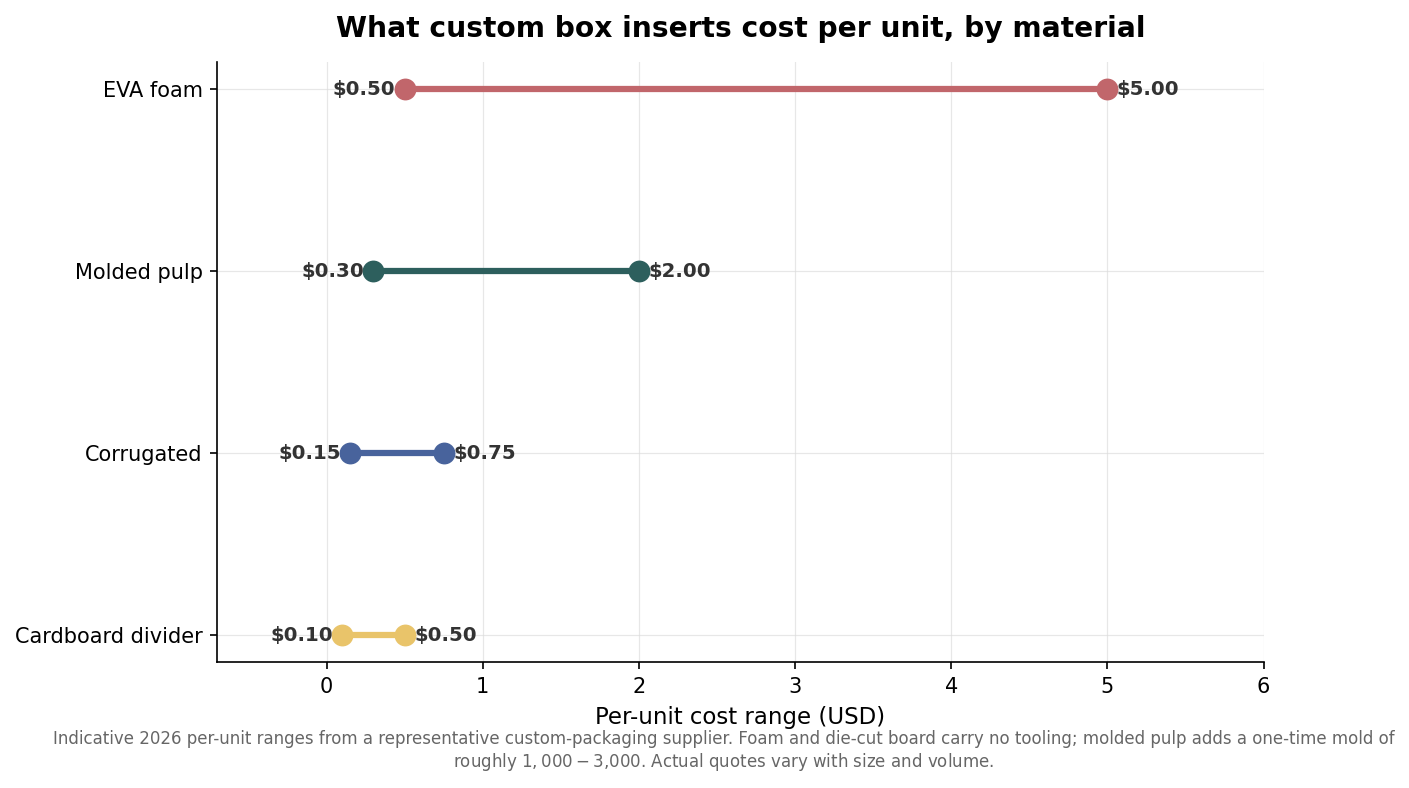
The per-unit number is only half the cost story. The hidden line item is tooling. Foam is CNC-routed straight from a CAD file, so there is no separate tooling charge, and die-cut board inserts are cut from flat stock with an inexpensive die. Molded pulp is the exception: it needs a custom mold that typically runs about $1,000 to $3,000 as a one-time cost. On a small PR drop of a few hundred boxes that mold can dominate the math, while on a recurring program it amortizes to almost nothing. If you expect to reorder the same insert, molded pulp gets cheaper every time; if this is a one-off, a printed board tray often wins on total cost.
The protection-versus-planet trade you cannot dodge
There is no insert that maxes out every axis, and it helps to see the trade plainly. Foam is the clear winner on cushioning and the clear loser on recyclability. The three paper-based options all recycle well, but their protection drops as they get cheaper, from molded pulp’s contoured cushioning down to a divider that only keeps items from touching.
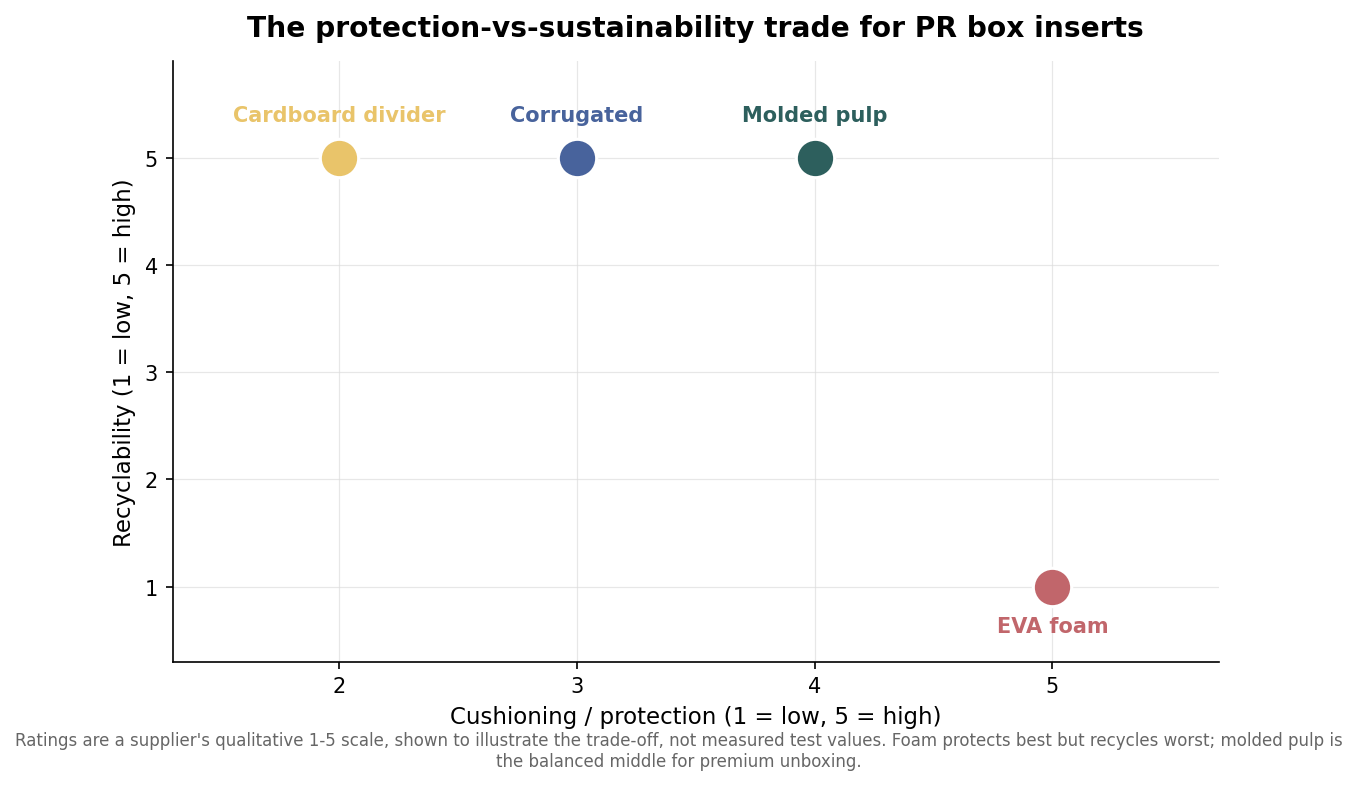
For a PR box specifically, that upper-middle zone is usually the sweet spot. Molded pulp gives you most of foam’s snug, custom fit and premium impression while staying recyclable, which is why it has become the default for eco-conscious beauty and lifestyle launches. Reserve foam for genuinely fragile or heavy hero products where a cracked item would sink the whole send, and reach for printed board when the product is light and the story is the graphics.
Match the insert to the product and the moment
Start from the product, not the aesthetic. A single fragile hero item, such as a glass bottle or a device, justifies foam or a well-designed molded pulp tray, because the cost of one shattered unit on an influencer’s doorstep is far higher than the insert. A curated multi-item set, the classic beauty or snack PR box, is a job for a molded pulp or printed board tray with defined pockets, so each piece has a home and the arrangement photographs as intentional. A lightweight single product with a strong visual identity can ride on a full-color printed platform that doubles as brand real estate. And when the brand’s entire pitch is sustainability, the insert has to back that up, because a plastic foam tray inside a kraft box is the kind of contradiction creators notice and mention on camera.
Lead time and minimums
Finally, let the calendar influence the choice. Foam and die-cut board move fast because there is no mold to build, so they suit tight timelines and last-minute additions. Molded pulp’s custom mold adds real weeks of tooling before the first insert exists, which is fine for a planned launch but painful for a rush. Minimums for custom PR boxes themselves can start low, in some cases around 50 units, which keeps small, targeted sends viable, but a molded pulp mold only pays off across a larger or repeating run. Decide early, because the insert is the one component most likely to add tooling time, and pin it down before the box artwork is finalized so the two are engineered to fit each other rather than forced together at the end.
Leave a Reply